

Tanzania consistently ranks fifth in cashewnuts production globally, following Ivory Coast, India, Vietnam, and the Philippines. This strong performance underscores the country’s significant role in the global cashew industry and its importance as an agricultural powerhouse in Africa.
About the chart
Tanzania Cashewnuts Production.
Period covered
1961 to 2022
Source
FAOSTAT, https://www.fao.org/faostat/en/#data/QCL
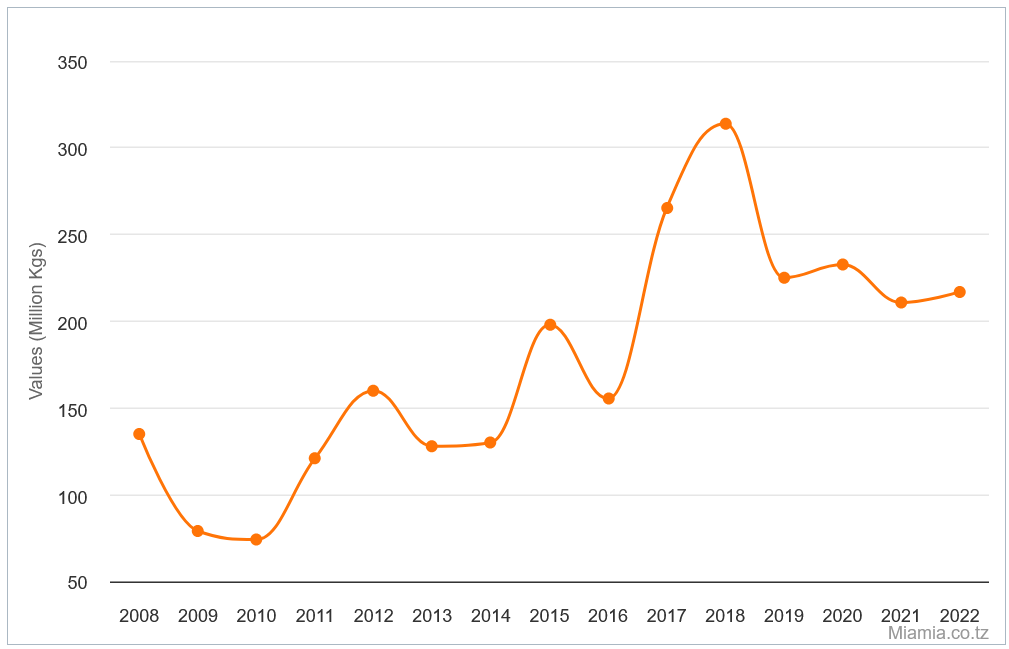
In 2016, the country produced 155 thousand metric tons of cashew nuts, which increased significantly to 265 thousand metric tons in 2017 and further to a peak of 314 thousand metric tons in 2018. However, production declined to 225 thousand metric tons in 2019, followed by a slight recovery to 233 thousand metric tons in 2020. In 2021, production dipped again to 211 thousand metric tons, before rising to 217 thousand metric tons in 2022.
Growth trends and drivers of Tanzania’s cashewnuts production
Early Growth (1961–1973)
Tanzania’s cashew nut production saw significant growth in its early years. Between 1961 and 1971, production increased steadily from 50,000 tons to a peak of 126,409 tons, driven by the expansion of cashew farming and government support. The early 1970s marked a golden era, with production reaching its first peak of 145,080 tons in 1973. This period reflected high efficiency and investment in the sector.
Decline and Challenges (1974–1987)
Following its peak, the industry faced a sharp decline. By 1987, production had dropped to 18,490 tons, representing a major contraction. This downturn was caused by economic instability, poor management practices, aging plantations, and limited access to modern farming techniques. These challenges highlighted the urgent need for reform and rejuvenation.
Recovery Phase (1990–2000)
The 1990s marked the beginning of recovery for the cashew sector. Production gradually climbed from a low of 17,060 tons in 1990 to 121,600 tons by 2000. This resurgence was spurred by government and donor interventions, including rehabilitation programs for cashew plantations and liberalization of the industry. Policy reforms encouraged private investment and created a more conducive environment for growth.
Modern Growth Era (2000–2022)
Since 2000, Tanzania’s cashew nut production has experienced remarkable improvements. The sector reached a record high of 313,826 tons in 2018, driven by government subsidies, increased private sector participation, and the adoption of high-yield cashew varieties. Rising global demand for cashews further incentivized farmers to expand cultivation. Despite occasional fluctuations, production remained robust, with 216,906 tons recorded in 2022.
Key Growth Drivers
Several factors have underpinned Tanzania’s cashew production growth. Policy reforms and liberalization opened up the industry to private investment and increased market efficiency. Government support, such as subsidies for fertilizers and pesticides, and investment in extension services, enhanced productivity. Technological advancements, including improved cashew varieties, helped modernize farming practices. Finally, rising global demand for cashews created profitable opportunities for farmers, making the crop a key contributor to Tanzania’s agricultural economy.
Related charts
Tanzania pharmaceuticals imports
Tanzania pharmaceuticals imports stood at USD 270 million in 2011…
Tanzania cashew nuts production
Tanzania is the 6th top producer of cashew nuts in…
Tanzania cashew nuts exports
Tanzania is one of the largest exporters of cashew nuts…
 Kessy Juma is the founder of Miamia Trading Company (miamiatz). He is a Techpreneur with roots in accountancy. He believes that any business is good as long as it caters to the right market using the right strategy. 


 |
